![[Next]](../../../../Images/SmallIcons/back.gif)
![[Next]](../../../../Images/SmallIcons/right.gif)
Several research thrusts are included in this activity. On-going with additional funding and to be included in the synthesis are a study of the terms of trade between agriculture in San José Llanga and the urban/ industrial sector. A second is a typology of farmers that distinguishes among different strategies pursued in semi-arid crop livestock systems was developed. The third study is on strategies under stress (delayed rains), result of which a second survey was developed and applied to assess household's income, resources, production strategies and food storage. The survey data collection and processing has been completed, this research activity continues in 1995-1996.
Problem Statement and Approach.
An institutional factor affecting the dynamics of peasant economies is the evolution of the terms of trade between the products that peasant households sell in the markets and the products that they buy. The analysis of this evolution allows us to understand if producers in their relationship with the market, given specific economic conditions and a specific region are "winners" or "losers", and what are the levels of risk created by this economic environment. An example is understanding the impacts of structural adjustment on the peasant economy given specific ecological condition. It also allows us to identify which peasant products procure real monetary income increase or decrease over the years. The evolution of terms of trade plays a very important role in determining peasant strategies in such aspects as: the degree of integration into the market economy, the relative importance of production for self consumption and production for sales, the relative importance that is given to different activities, explaining changes over time in the production portfolio.
In Bolivia, very few studies on this topic exist and they address the problem at the aggregate level, looking at the evolution of the terms of trade between agriculture as a whole and industry (without differentiating between peasant and commercial agriculture), or at best between the Andean region and the Lowlands (without making distinctions between Altiplano and Valleys).
In order to understand the impacts of changes in the economic environment of agropastoral systems in the Central Altiplano, the SR-CRSP sociology project undertook a comprehensive study of the evolution of terms of trade in the region. All the necessary data have been collected and is being processed.
Progress
In order to build an index of peasants household expenses, 33 products were selected that are commonly purchased by peasant families in the Central Altiplano, and gathered the nominal prices for these products from 1970 to 1990. To ponder the relative weight of each of these products in the household's portfolio of purchases the health and nutrition survey of San José in 1993 was reviewed. This offers a detailed account of the frequency and quantity of several food items purchased. The results of this analysis were compared with similar surveys in other rural areas. According to the majority of them, food purchases represent around 60 percent of all peasant monetary expenses in the region. To build the index of peasants agricultural monetary incomes, prices paid to producers for 22 goods were collected, and a weighted of prices was constructed according to the relative importance of each product according to the 1992 agricultural gross value of production for La Paz department.
Finally prices of national minimum wages and building industry wages since 1983 were collected in order to compare the evolution of peasant monetary incomes with the evolution of the national minimum wage and revenues in an urban sector where many rural migrants work.
With these data, two types of analysis are planned in 1995-1996. The first one will be more general and will consist basically of comparing the evolution of the weighted relative prices of all the goods that are produced and purchased by peasant households in the Altiplano. This first analysis will provide insights to the ways a peasant household economy in the Altiplano are or were affected during the last 25 years by the dynamics of the national economy.
The second one is more sophisticated and the objective is to determine more precisely the impacts of the evolution of terms of trade on the real income of rural households units in San José. In order to do so it will be necessary to build for each household of the 45 sample an index with a numerator that includes the following variables: the goods that are produced in a household and the prices of these goods; the income obtained through wages and remittances; the participation of agricultural income in the total income of the economic unit. The denominator includes: the quantity of agricultural goods that are consumed in the household and the prices; the goods that are purchased in the market and their prices; the factors of production in San José and their prices; the respective participation of consumption/production in-kind, consumer goods purchased and expenditures in the factors of production as part of household's total expenses. To build this index we will rely on the information that several socioeconomic surveys and case studies of San José.
Problem Statement and Approach
Variability and the probability of negative outcomes - risk- is inherent to semiarid environments in the tropics. Peasant households confront this risk through a variety of production and consumption strategies that increase food security. Livestock play a role in risk mitigation in agropastoral systems. Many other activities are also instrumental in a diversification strategy that contributes to the persistence of families at different stages in their life cycle. To understand the several coping strategies developed to minimize risk and increase food security a household survey of 45 families was developed, gathering information on resources, factors of production, patterns of consumption and sales and characteristics of production.
Progress
Peasant strategies were analyzed from the household survey conducted in 1993. Preliminary findings were presented in last year's annual report. The objective of the analysis was to identify household strategies both in on-farm and off-farm production activities, an the role resources and markets play in defining these. Several variables were considered in the cluster analysis. A dendogram was constructed (Figure 2) from which four clusters were identified. A rectangular data matrix was used to compute Normalized Euclidian Distances between objects for its clustering metric normalized distances are root mean square distances. Normalizing by the sample size allows comparison of clustering across different size samples with or without missing data.
The dendogram presented in Figure 2 identifies two large groups that are defined being age the clustering factor, underlying the importance of stage in the life cycle in identifying producer groups. The first group I identifies the elderly population, which subdivides itself into two group, farmers with more cattle (I.2) and farmers with more sheep and poorer than the first subgroup. The second large group (II) is formed by farmers in their productive years. Variables that were significant in this grouping were resources, understood as availability of range and irrigated lands, alfalfa fields, access to labor, and type of sheep and cattle (Criollo as opposed to improved). The characteristics of the technologies contributed to defining the names of the subgroups, II.1 peasant households with improved sheep and cattle and II.2 the Criollo, generally with local animals, limited cultivated forages, and access to CANAPAS. Table 4 highlights some of these characteristics.
Figure 2: Dendogram
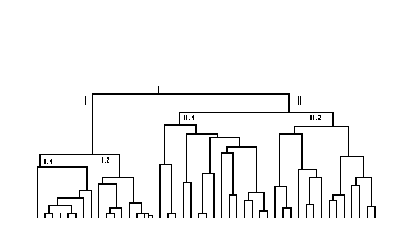 |
Table 4 : The Productive Group
|
Variable |
Group I: Improved |
Group II: Criollo |
|
Age (years) |
45.7 (11.3) |
41.6 (12.6) |
|
Labor (units) |
3.4 (1.2) |
3.3 (1.5) |
|
Criollo Sheep (numbers)** |
4.2 (5.8) |
20.2 (14.7) |
|
Improved Sheep (numbers)** |
27.2 (28.9) |
6.9 (13.4) |
|
Improved Cattle (numbers)** |
4.8 (1.9) |
1.3 (1.6) |
|
Criollo Cattle (numbers)** |
0.3 (0.5) |
2.5 (2.2) |
|
Forages (hectares)** |
4.9 (3.0) |
1.6 (1.5) |
|
Wages (Bolivianos,Bs./year) |
1,000 (1,718) |
299 (507.4) |
|
Household Consumption ** (Bs./year) |
4,981.3 (1,889.2) |
2,444 (1,475.5) |
|
Cattle Net Income (Bs./year) |
1,784.2 (2,276.7) |
1,142.5 (1,870) |
** statistical difference between means at 0.05. Standard deviations in parenthesis.
Labor and age were not significantly different between subgroups, unlike their access to cultivated forages and type of animals. There were clear differences among the two subgroups in terms of consumption. This research is on-going and the analysis will be expanded by the comparisons that will be developed with the second survey carried out in July of 1995.
Problem Statement and Approach
After the discussion of the Synthesis Workshop that took place in December 1994 in Logan Utah, it was clear that the data gathered so far did not reflect a bad year, as defined by the farmers. In November of 1994 rains were delayed affecting planting of crops, and frosts killed some of the food crops in February 1995. In order to track the severity of both events to look at the role of livestock under these conditions a survey was carried out to determine if there were changes in the strategies farmers designed and how food security was affected.
Progress
The second annual survey of production and income in San José
The 1994-1995 agricultural year has been affected by late and well under the average levels of rains. In order to have an insight of the impacts of such climatic situation on agricultural production and of the households strategies to cope with this type of perturbation, a survey on income and production that was revised and applied in July and August 1993 in San José. The 1992-93 climatic year was considered as an "around the average" one. The survey was implemented in July and August 1995 with all but three households interviewed in 1993. The missing (because they had migrated or died) were replaced by others. The same questions were asked, and a new section was added with questions on: history of crops (do you cultivate more or less food/forage crops than before and why?); food storage and reserves; average money spent to purchase food each week.
The data processing was completed at the end of November and we are now in the process of analyzing the information. The comparison of the results of this survey with those on the 1992-93 one will be very helpful to understand the dynamics of the production systems in San José Llanga region.
![[Next]](../../../../Images/ARROWS/Ra.gif)